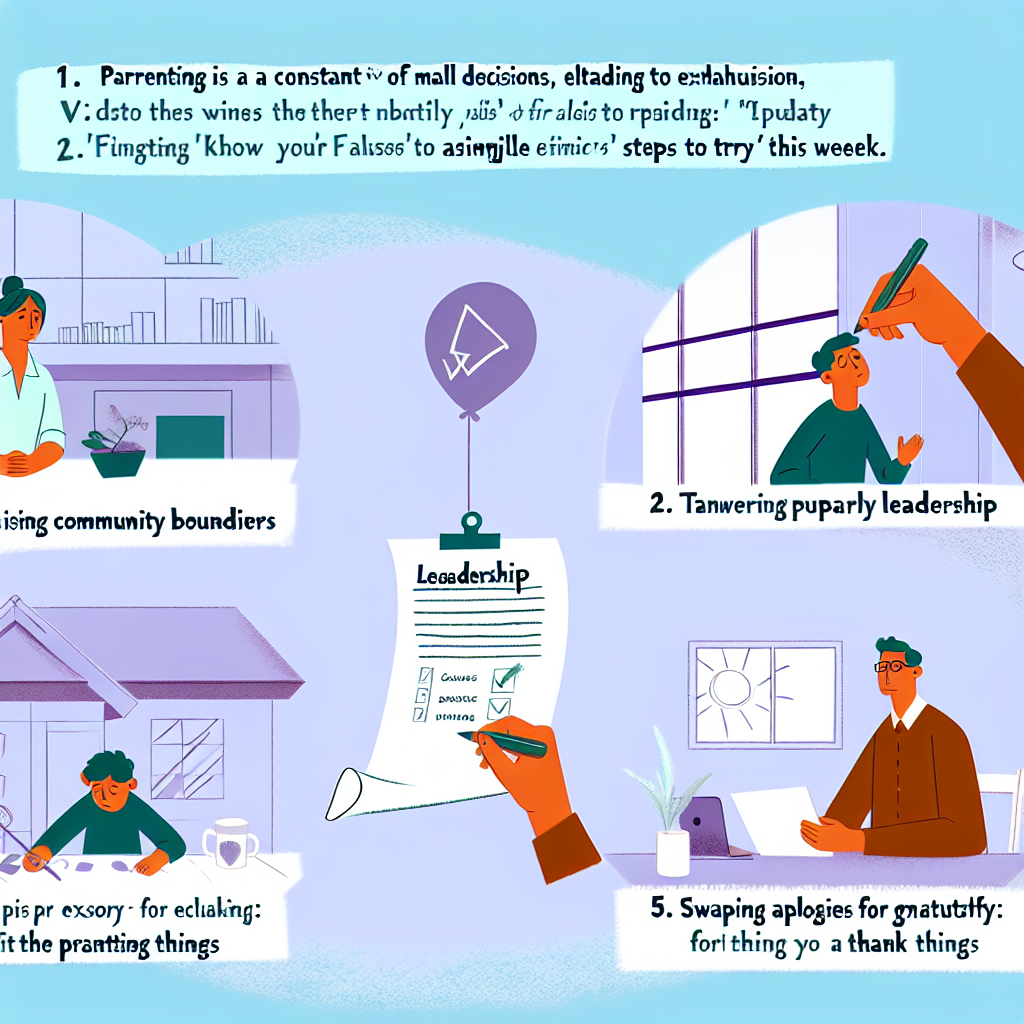
# Pause, Pen, Thank You: Small Habits That Quiet the Chaos for Busy Parents
Parenting often feels like living in a hall of mirrors: every little choice reflects back a dozen new ones. What’s for dinner, who’s picking up daycare, did you remember the permission slip? Meanwhile the brain is on loop, offering helpful lines like “I’ll do it after one show” or “I’ll just dive into that group debate for five minutes.” Spoiler: the show ends, the permission slip is still missing, and you’re knee-deep in a WhatsApp thread about whether children’s cartoons are secretly indoctrination.
I’ve got sticky cereal bowls, a drawer of unmatched socks, and a weekly inbox I pretend doesn’t exist. But I’ve also learned that tiny shifts—three-minute boundary-setting, a scribbled note, a phrase swap—can quiet the noise enough to notice the good stuff. Here are five small habits I try (and sometimes spectacularly fail at) that actually move the needle.
## Keep your communities safe and focused
Online parenting spaces can be sanctuaries or stress traps. A neighborhood Facebook group saved me when my toddler needed a last-minute babysitter; a school chat thread once made bedtime feel impossible because someone posted a conspiracy about pajamas.
Practical moves:
– If you run a group, put one-sentence rules in the header. “This is for childcare swaps, local recs, and kid-friendly events—no politics.” Short and boring is gold.
– If you’re a member, mute the threads that make your jaw clench. There’s zero parenting merit badge for consuming every argument.
– Choose one place for real connection (an honest friend, or a small local group) and treat it like a garden: weed it and water it.
I once left a heated thread only to rejoin out of FOMO, because apparently my default is Emotional Participation. Muting tools are my new best friend.
## Leading, and knowing when to step back
Someone has to keep group traditions alive—carpool lists, bake sale sign-ups, the awkward PTA email chain. That someone often becomes an unpaid project manager: badges, spreadsheets, guilt.
It’s okay to hand off the megaphone. I coached a friend through passing leadership of our preschool auction. We created a two-week overlap, a cheat sheet, and a celebratory coffee for the outgoing lead. She cried a little (it was mostly happy), and the auction lived on.
If you’re stepping down: document the basics and ask for help. If you’re receiving thanks: mean it. A quick, honest “thank you for holding this for so long” goes a long way.
## Outsmart your brain: write excuses down before you act
That tiny voice that delays bedtime or dishes? Catch it with ink. As soon as you hear “I’ll do it later,” write it down: “I’ll do bedtime after this episode.” Put it somewhere visible for five minutes.
Why it works: writing creates distance between impulse and action. The excuse often looks flimsy on paper.
Try this hack: keep a 3×5 card by the couch or a note in your phone. When you’re tempted to delay something important (packing lunches, signing forms, finishing homework help), jot the excuse, wait five minutes, then decide. Nine times out of ten, the paper version is less persuasive than the voice in your head.
Confession: I once wrote “I’ll start nap training on Monday” on a sticky, stuck it to the fridge, and realized Monday was three days away. I still haven’t found that sticky, but the fridge is now heroically organized.
## Turn confusion into progress
Parenting advice comes at you in jargon—“sleep association,” “gentle extinction,” “division of responsibility.” Instead of nodding and powering through, keep a confusion list: every time you think, “Wait—what does that mean?” write it down.
After your reading session or doc appointment, come back to the list and look up answers or ask a professional. You’ll stop skimming and start understanding. That clarity makes decisions less paralyzing and more practical.
I keep one note titled “Confusion” on my phone and confess it to my pediatrician at checkups. They love it. I love it. My child remains oblivious and stubbornly adorable.
## Stop apologizing for taking up space—say thank you instead
We are conditioned to say sorry for existing: “Sorry I’m late,” “Sorry for the mess,” “Sorry to interrupt.” These tiny apologies make you smaller and put others in the uncomfortable spot of absolving you.
Swap in gratitude when an apology is just social muscle memory. Try: “Thank you for waiting” instead of “Sorry I’m late,” or “Thank you for listening” in place of “Sorry for rambling.” It shifts the dynamic from self-shrinkage to mutual kindness.
Note: actual apologies are still important. If you’ve hurt someone, say sorry and mean it. This tip is about stopping the autopilot “sorry” for ordinary life.
## Putting it together: a mini-practice you can start tonight
Pick one and try it for a week:
– Clarify what you want from online parenting spaces and mute the rest.
– When your brain offers a delay, write the excuse down first and wait five minutes.
– Start a “Confusion List” for anything you’re learning about family life.
– Replace casual “sorries” with “thank yous” for a day and notice the difference.
I tried the “thank you” swap at a school pickup and almost snorted because it felt weirdly fancy. By day two it felt normal—and kinder.
## Wins, fails, and the honest middle
Win: I once used the excuse-writing trick to skip doomscrolling and finished my kid’s science project with time to spare. She glued planets onto cardboard like a shining tiny astronaut of joy.
Fail: I agreed to moderate a new moms’ chat for “just a month.” Two years later I was still replying to emoji-filled project management messages and wearing the unofficial crown of “Group Mom.” I handed it off with a combination of snacks and a spreadsheet titled “You Can Do This.”
Parenting isn’t about being perfect; it’s about small, sustainable nudges that make everyday life smoother. These habits won’t transform chaos overnight, but they give you a little breathing room where the important stuff—snuggles, crashes, laughs, the real human moments—can happen.
What tiny habit has actually helped you survive parenting chaos (or spectacularly failed in a way that became a great story)? Share one here — I’ll start the conversation with mine: I once apologized for an accidental glitter explosion, then thanked a friend for helping me clean it up. Your turn.